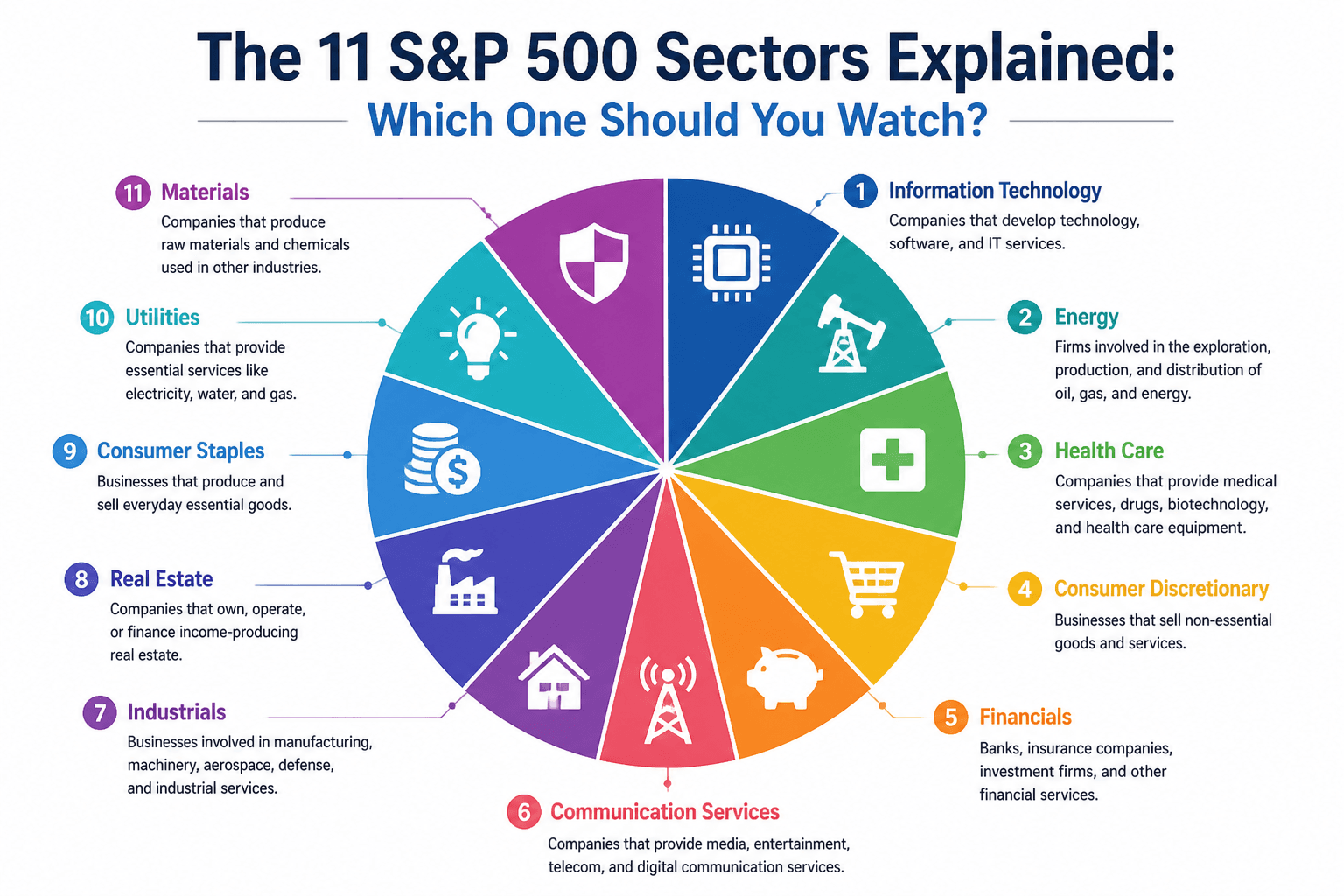
The 11 S&P 500 Sectors Explained: Which One Should You Watch?
Quick Answer: The S&P 500 consists of 11 sectors that represent various industries in the U.S. economy. Understanding their characteristics, economic sensitivity, and performance trends can help you make informed investment decisions.
Key Takeaways
- The S&P 500 is divided into 11 sectors based on the Global Industry Classification Standard (GICS).
- Each sector has unique characteristics and key stocks, influencing its performance during different economic cycles.
- Sector rotation allows investors to shift their focus to sectors that are expected to outperform based on economic conditions.
What Are the 11 S&P 500 Sectors?
The S&P 500 sectors are categorized into 11 distinct groups, each reflecting different aspects of the economy. They include:
- Information Technology
- Health Care
- Financials
- Consumer Discretionary
- Consumer Staples
- Energy
- Utilities
- Materials
- Industrials
- Real Estate
- Communication Services
Understanding these sectors is essential for investors looking to capitalize on market trends.
How Do the S&P 500 Sectors Perform During Economic Cycles?
What Is Sector Rotation?
Sector rotation is an investment strategy where investors move capital between sectors based on economic cycles. Different sectors perform better at various stages of economic growth or contraction. For example, during an economic expansion, cyclical sectors like Consumer Discretionary and Industrials often outperform. Conversely, during recessions, defensive sectors like Utilities and Consumer Staples tend to hold up better.
Which Sectors Are Cyclical?
Cyclical sectors include:
- Consumer Discretionary (e.g., Amazon - AMZN)
- Industrials (e.g., Caterpillar - CAT)
- Materials (e.g., Freeport-McMoRan - FCX)
These sectors generally perform well when the economy is growing and consumers are spending.
Which Sectors Are Defensive?
Defensive sectors include:
- Consumer Staples (e.g., Procter & Gamble - PG)
- Health Care (e.g., Johnson & Johnson - JNJ)
- Utilities (e.g., NextEra Energy - NEE)
These sectors tend to be less sensitive to economic cycles, providing stability during downturns.
Characteristics of Each Sector
Information Technology
The Information Technology sector is characterized by high growth potential and innovation. Key companies include Apple (AAPL) and Microsoft (MSFT). This sector is generally resilient, outperforming when economic growth is robust.
Health Care
Health Care comprises pharmaceuticals, biotechnology, and medical devices. Major players like Pfizer (PFE) and UnitedHealth Group (UNH) indicate strong performance during both economic expansions and contractions due to consistent demand.
Financials
The Financials sector includes banks, insurance companies, and investment firms, with key stocks like JPMorgan Chase (JPM). This sector benefits from rising interest rates, which can enhance profitability.
Consumer Discretionary
This sector includes goods and services that are non-essential. Companies such as Nike (NKE) and Tesla (TSLA) thrive during economic growth, as consumers have more disposable income.
Consumer Staples
Consumer Staples consist of essential products like food and household items. Companies such as Coca-Cola (KO) and Walmart (WMT) are stable investments during economic downturns.
Energy
The Energy sector is influenced by commodity prices and is represented by companies like ExxonMobil (XOM). This sector tends to perform well during economic recoveries when demand for energy increases.
Utilities
Utilities provide essential services like electricity and water. Key stocks include Duke Energy (DUK). This sector is generally stable but offers lower growth potential.
Materials
The Materials sector includes companies that produce raw materials, such as Dow Inc. (DOW). This sector benefits from economic growth when demand for construction and manufacturing rises.
Industrials
Industrials encompass companies involved in manufacturing, construction, and transportation. Key players include Boeing (BA) and Honeywell (HON). This sector often performs well during economic recoveries.
Real Estate
The Real Estate sector includes investment trusts and real estate management firms. Companies like American Tower (AMT) are sensitive to interest rates and economic conditions.
Communication Services
This sector includes traditional media, telecommunications, and interactive media companies. Key stocks like Facebook (FB) and Netflix (NFLX) are affected by consumer spending habits.
When Should You Watch Each Sector?
Understanding when to focus on specific sectors can enhance your investment strategy. For instance:
- Watch Consumer Discretionary during economic expansion.
- Focus on Utilities and Consumer Staples during downturns.
- Invest in Financials when interest rates are rising.
By analyzing sector performance against economic indicators, you can make informed decisions.
Key Takeaways Revisited
- The S&P 500's 11 sectors offer diverse investment opportunities.
- Sector performance varies with economic cycles; understanding this can guide your investments.
- Utilize DailyFinz's sectors page for live data and insights to track sector performance.
FAQ
What is the GICS?
The Global Industry Classification Standard (GICS) is a system for classifying companies into sectors and industries based on their business activities.
Why is sector rotation important?
Sector rotation allows investors to optimize their portfolios by investing in sectors that are likely to outperform based on economic conditions.
How can I track sector performance?
You can track sector performance using tools like the DailyFinz market heatmap and market analysis.
Are all sectors equal in risk?
No, sectors have different risk profiles. Defensive sectors tend to be less volatile, while cyclical sectors can be more sensitive to economic changes.
How can I apply this knowledge to my investments?
By monitoring economic indicators and sector performance, you can adjust your portfolio to capitalize on expected trends.
Where can I find more information on specific stocks?
Visit the DailyFinz stock pages for in-depth analysis and insights on individual stocks within each sector.
Related Topics