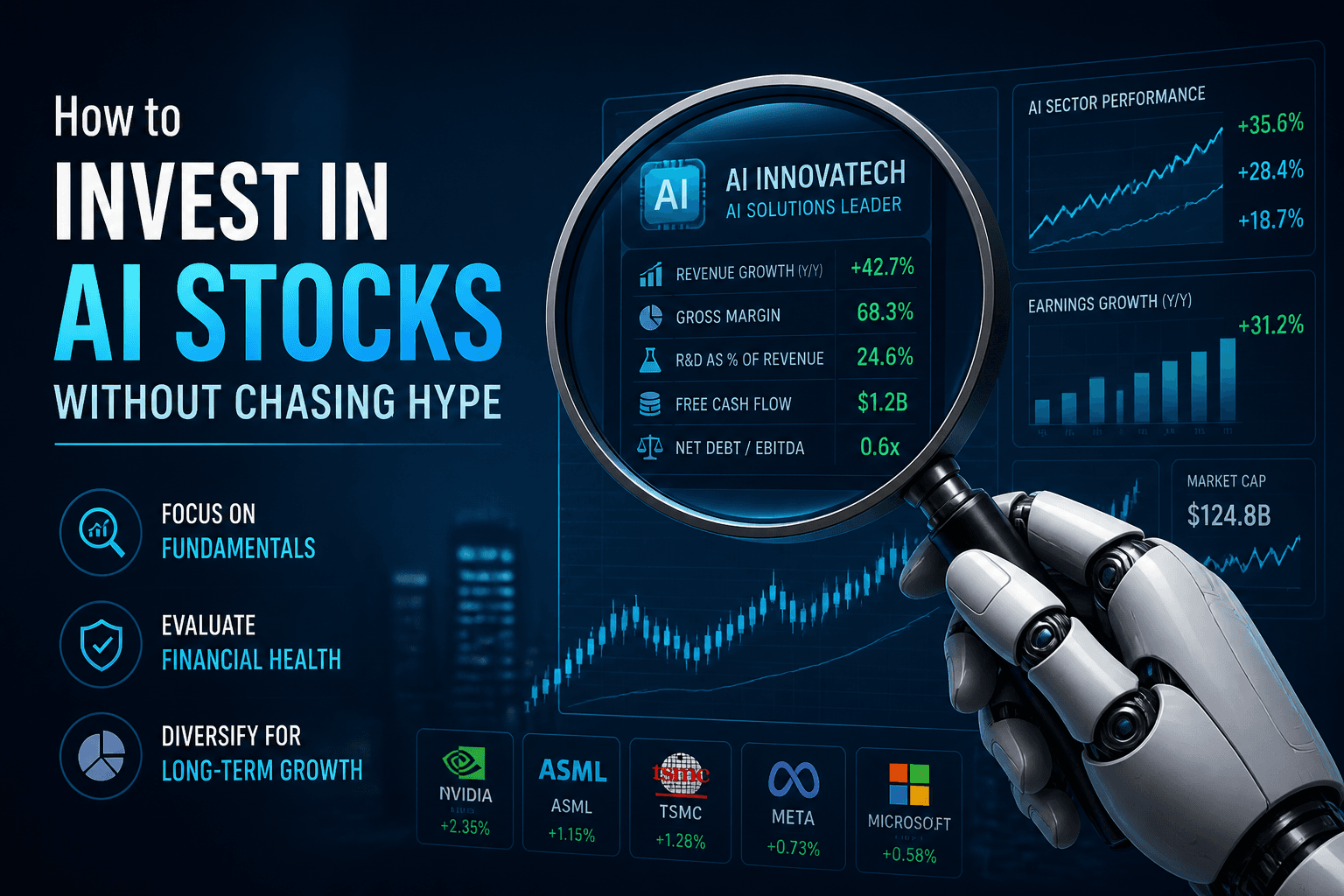
How do I invest in AI stocks without chasing hype?
Quick Answer To invest in AI stocks without chasing hype, separate true AI infrastructure plays (like semiconductors and cloud providers) from companies that only add "AI" to marketing. Use a valuation-first framework tied to measurable AI revenue, watch the AI capex cycle (training vs inference), and require management to show revenue attribution, margins, and customer traction before paying a premium.
Key Takeaways
- Distinguish infrastructure (chips, data centers) from branded AI products and require numeric disclosure.
- Track the AI capex cycle: vendor orders, cloud capex guidance, GPU/backlog signals.
- Use scenario-based valuation and incremental-margin tests to avoid paying for “optionality.”
- Look for management transparency (segment reporting, bookings, ARR) and real customer wins.
- Limit theme exposure and size positions by conviction and downside scenarios.
Why is separating AI infrastructure from AI branding important? AI infrastructure means the physical and software layers that enable model training and inference. Examples: GPUs/accelerators (semiconductors), data-center servers, networking, and cloud CPU/GPU instances.
AI branding is when a company—often outside infrastructure—adds “AI” to existing products or marketing without measurable revenue change. Marketing-led AI can inflate expectations without altering cash flows.
Real-world examples: NVIDIA (NVDA) is widely seen as an infrastructure play because its data-center GPU revenue and margins are disclosed. Microsoft (MSFT) and Amazon (AMZN) are cloud infrastructure/software players where Azure and AWS capex and SKU-level pricing can indicate real demand. By contrast, a consumer app that says “now AI-powered” but doesn’t show new bookings or ARPU (average revenue per user) may be branding.
What financial signals show genuine AI demand? Look for numbers, not buzzwords. Useful disclosures include:
- Segment revenue growth tied to AI products (e.g., Nvidia’s data-center revenue).
- Capex guidance increases from cloud providers (AWS, Azure, Google Cloud).
- Product-level metrics: bookings, deal sizes, ARR (annual recurring revenue), and retention.
- Unit economics: improving gross margins or attach rates for AI-enabled offerings.
- Vendor indicators: semiconductor lead times, backlog, billings for servers or accelerators.
If management cites “AI demand” but won’t quantify bookings or margins, treat that as weak evidence.
How should valuation discipline change for AI investments? AI creates optionality, but optionality should have a price. Don’t buy a story at multiples that assume flawless execution.
Steps to stay disciplined:
- Run three scenarios: base, upside, and bear. Tie each to conservative assumptions on market share, pricing, and margins.
- Use valuation metrics that matter: discounted cash flow (DCF) or EV/EBITDA tied to achievable margins rather than headline P/S when revenue is still speculative.
- Check implied growth: what CAGR does the current price imply? If the implied growth requires market domination with no execution risk, the premium may be unwarranted.
- Prefer companies where AI lifts margins or retention, not just top-line narrative.
Example: paying a high multiple for a software firm that claims “AI will boost retention” is a different decision than paying for a chipmaker with disclosed rising gross margins and capacity-constrained sales.
How does the AI capex cycle affect timing and risk? The AI capex cycle has phases: infrastructure investment, deployment, utilization, and refresh. Training large models drives high upfront demand (GPUs, networking); inference demand scales later as models are productized.
Signals to watch:
- Public cloud capex guidance (MSFT, AMZN, GOOGL) and data-center buildouts.
- Semiconductor lead times and customer inventory levels.
- Earnings commentary on backlog, pricing, and unit shipments.
- Component supply-chain indicators like memory and high-end interconnect demand.
AI cycles can overshoot on the upside (supply constraints) and swing quickly when models or implementations stall. Align position size and entry points to capex-cycle signals.
What framework should you use to evaluate whether AI is actually driving revenue? Use a four-part checklist before paying AI multiples:
-
Attribution: Does the company break out AI-related revenue or bookings? If not, how else can you measure contribution (product usage metrics, ARPU, contract descriptions)?
-
Margins: Are gross and operating margins improving with AI rollouts? Real infrastructure often raises margins; marketing AI may not.
-
Customer traction: Are there named customers, repeatable large deals, and multi-year commitments? Look for vertical use cases (e.g., healthcare imaging deals, enterprise search contracts).
-
Capital intensity and dependency: Who shoulders the capex? If cloud vendors incur the capex and charge consumption-based fees, assess monetization and pricing power.
Apply these tests and score each company. Only companies scoring high on at least two dimensions should be considered for premium valuations.
How big should my AI exposure be and how should I size positions? Don’t bet your portfolio on a single theme. Treat AI as a theme allocation within a diversified portfolio.
Sizing tips:
- Cap exposure to any single theme until it proves durable (example: 5–15% of portfolio depending on risk tolerance).
- Size individual positions by conviction and downside — larger for companies with transparent metrics and capital-light models.
- Rebalance after material news or when implied growth assumptions shift.
Remember: this is not personalized financial advice. Adjust sizing to your goals and risk tolerance.
Red flags that indicate hype, not substance
- Rebranding with no quantitative disclosure.
- Acquisitions at very high multiples for “AI talent” without revenue synergies.
- Management refuses to discuss unit economics or customer traction.
- One-off pilot announcements without long-term contracts.
FAQ Q: Can small-cap AI plays outperform infrastructure names? A: Yes, but small caps often carry execution and liquidity risk. Infrastructure leaders tend to show clearer revenue attribution and scale.
Q: Should I avoid all companies that mention AI in marketing? A: No. Mentions can precede real product changes. Prioritize firms that back claims with numbers in filings or investor calls.
Q: How do I monitor AI capex signals in real time? A: Watch cloud provider guidance, semiconductor lead times, and chip vendor backlog updates in earnings calls and supplier commentary.
Q: Is a high P/S ratio always a warning sign? A: It's a warning sign if future growth and margins don't justify it. Use scenario analysis to decide if the premium is warranted.
Q: Where can I screen for companies with real AI exposure? A: Use a thematic screener that filters for disclosure of AI-related revenue, capex trends, and margin expansion. Try the DailyFinz [stock screener] for AI-related filters.
Closing — tools to help you research
- Check sector trends on the DailyFinz [sector overview].
- Scan real-time movers with the [market heatmap].
- Build and test AI-theme portfolios in the [stock screener].
- Read deeper company write-ups on our [stock pages] and broader [market analysis].
Do your own research and consider speaking to a licensed advisor. DailyFinz gathers data and tools to help you make more disciplined decisions about AI exposure.
Related Topics